Danke. (Der Link ist falsch und sollte https://www.europa-lehrmittel.de lauten. Ich weiß nicht, wo ich die von Ihnen genannten Informationen finden kann.)
Das stimmt der Link war falsch. Die Tabellen findet man in dem Buch: Grundschnitte und Modellentwicklungen. Ich hoffe das hilft weiter:)
Bonjour,
Je n’ai pas bien compris quels sont les points que vous changez pour rapprocher les lignes de côtés? Merci pour votre aide.
Das ist hier der Punkt A1. Er ist auf 0. Setzte ich ihn auf 10, wandert das Vorderteil 10 cm nach links.

Thank you so much @Scholli
How did you establish the two lengths between the back/front shoulder and chest?
Still looking for how to calculate armhole depth. I have a total armhole measurement but confused as to the length of the vertical line on which to plot UPPER CHEST for armhole.
Please help.
Thanks.
The easiest way is to pass a strip of paper around the body and under the arms. Measure from the neck back to the top of the paper for the armhole depth measurement. Then draw a line on the paper at either side in a straight line from the widest part of the front and back arm, then remove the paper strip and measure the distance between the 2 marks for the armscye width.
Hi Mumu: In my YouTube video, I explain how I calculate the armhole and how to make the sleeve pattern. I hope you’re interested. Another thing you can do in your case is to lower the perpendicular line from the end of the shoulder to the armhole line with the “Point - intersect Line and Perpendicular” tool, and then you’ll see how much it measures.

TYVM, Grace. A question please. It seems as if Mueller is attributing 2/3 armsyce width to the back and 1/3 to the front.
However when I look at patterns it seems as if the horizontal is attributed the other way.
Which is correct, please?
Also, double checking, the calculation is Chest/8, not Bust/8.
Yes?
So on the Front chestline, I plot Chest/4-4.c.m. + arm syce width.
Back=Chest/8 + 5.5 c.c+ arm syce width.
I plan on making a simple bodice but the armhole shaping…has me stuck!
So, twenty failures later, I’m hoping to make the final one for this lifetime.
Thank you!
Appreciate your guidance very much!
Happy Thanksgiving
[quote=“Kate, post:29, topic:3269”] It seems as if Mueller is attributing 2/3 armsyce width to the back and 1/3 to the front.[/quote]
Yes, this is normally correct, however some pattern systems just divide the armscye width in half, which puts the side seam slightly more towards the back. If we’re going to do things really, really correctly, the side seam needs to be a perfect line fthat’s parallel to the floor.
Are you sure that this is Chest/8? The formula should read: Front = (Chest/4)-4.c.m. and then place a point from this point going towards the front with the formula: arm syce width/3 and the Back = (Chest/4) + 5.5 c.m. and then place a point from this point going towards the back with the formula: (arm syce width/3)*2
You mustn’t forget that the chest measurement is the whole circumference of the chest, so you don’t add the armscye onto this measurement, you deduct if off this measurement to find the across back and across front measurements.
I normally do brackets around the multiply & divide when it has more than one / * - + so that it doesn’t make any mistakes.
I hope this helps you.
Technically you don’t need the ()'s here, but it does make it clearer. On the other hand this would require ()'s… Chest / (4 + 5.5).
I stand by the formula that I used unless I’m completely missig the plot:
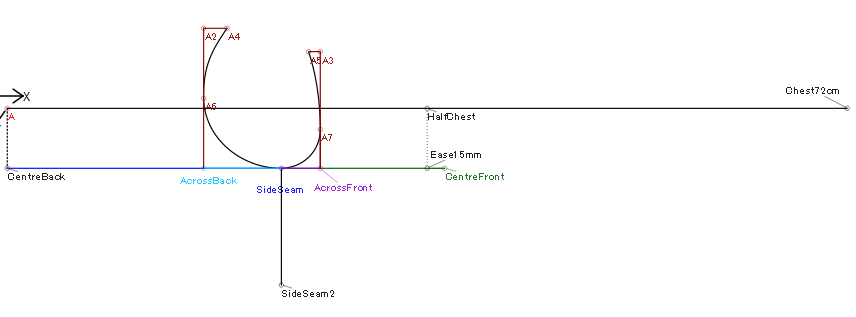
Test Chest Width.sm2d (4.5 KB)
I’m not arguing the formula… I’m just stating that you need to put ()'s around addition & subtraction if that is the intent.
Chest / 4 + 5.5 evaluates the same as (Chest / 4) + 5.5, whereas Chest / (4 + 5.5) does not.
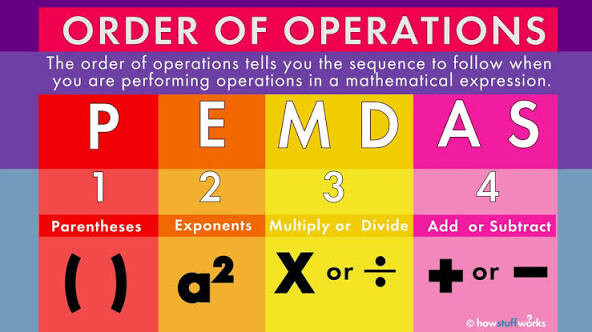
“The order of mathematical operations is PEMDAS, which stands for Parentheses, Exponents, Multiplication and Division (from left to right), and Addition and Subtraction (from left to right). This acronym provides the rules for solving expressions with multiple operations to ensure a single, correct answer.”
 Ah! ok, so I was missing the plot. Sorry about that.