Referencing unaligned angles

My maths brain is not mathing right now.

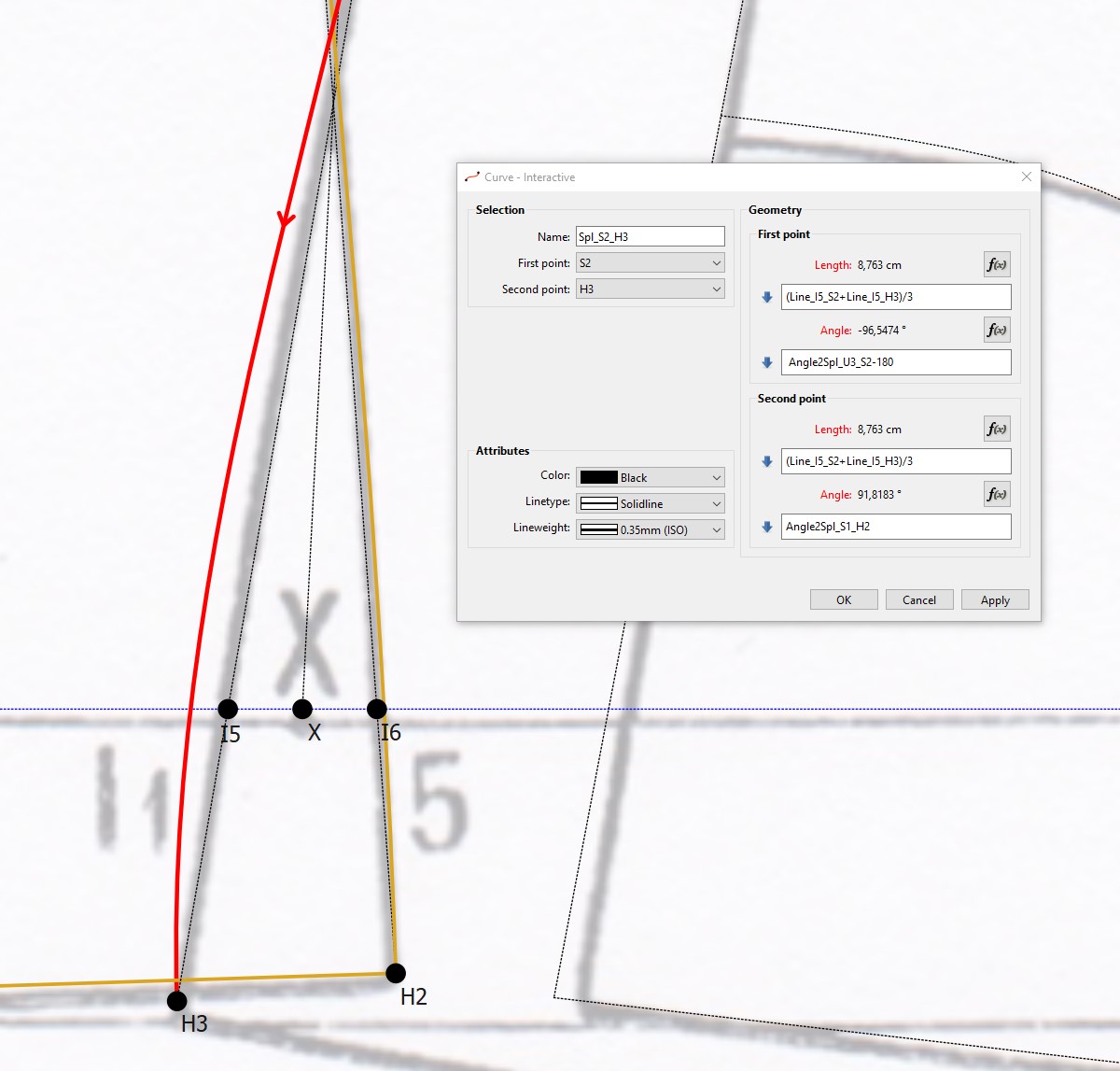
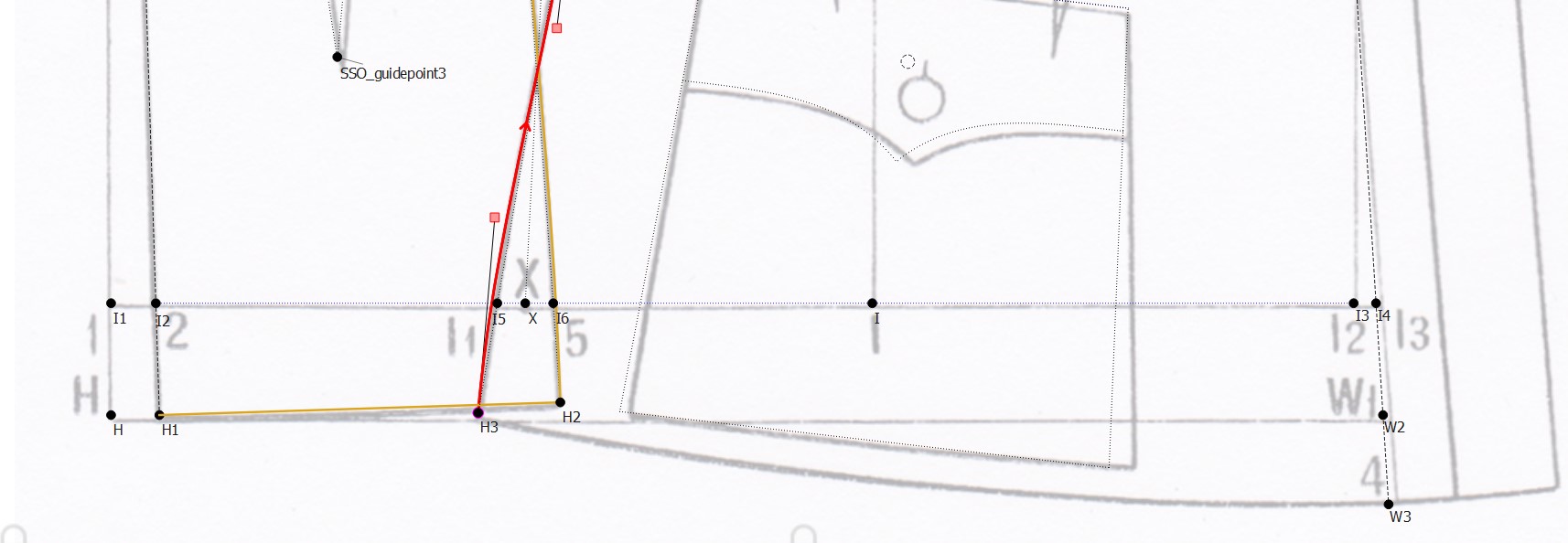
I have a straight line coming from the left to H2 (in orange), which then defines a spline curve up. It starts at an 90 degree angle.

Now I need to define the other side of the hem (from H3) and the side seam.

So the red curve from H3 will define the curve H3 - W3, so that the resulting seam is at a straight angle.

Is there a method to this madness that I could use to define a 90 degree curve here? Or is there another aproach to this hem & side seam? On the original jackets that I took apart it seems to me that the hem - sideseam corner is 90 degree angle on both sides, but this could very well just be distortion over time. In any case they are S-curves.

2 Likes

Du musst einfach den ersten Winkel 90° zum Saum von H3 bringen = Winkel des Saumes minus oder plus 90°, dass hängt davon ab mit welchem Punkt deine Kurve startet.

2 Likes

Use the Curve angle at point H3. Each curve has 2 angles - splines will have more - that represent the Control Point angles. For ex: For Spl__9_A1 here has 2 angles… you would then add or subtract 90 from which ever angle you’re using.

For ex:

Note:I believe the CP1 angle comes first in the Curve Angles list. Here’s that curve:

And technically the length of your CPs of the hem curve should be formulaized so they resize properly with measurement changes… which has been covered in other topics.

3 Likes

Thanks!

The angle of the red spline is dependant on the yellow/golden side seam angle.

But since the reference point is 0 degrees and both the sides are angled from neat right angles, my brain is not getting around how to calculate the yellow angle in relation to the H3 angle.

I suppose the dotted lines come into play here as well? I’ve now only copied the H2 curve angle to this.

The dotted lines going through I5 and I6 are the side seam “base lines” used to calculate the point positions of the points. The curved lines - as far as I’ve understood - just shape the jacket side seam in a more pleasant fashion.

2 Likes

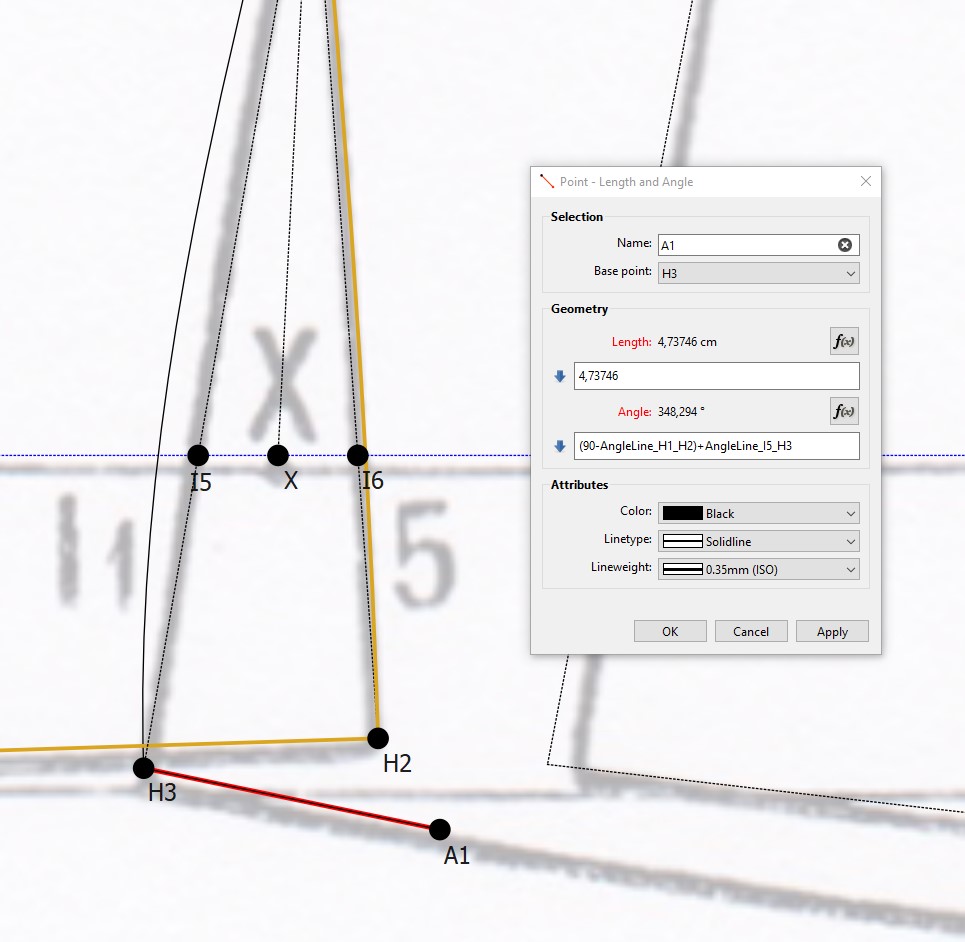
This is the formula I came up with to define this guidepoint A1 (for testing purposes), but I am not sure this is the correct angle.. It’s slightly more than the I5-H3 angle would be at 90 degrees.

transparent

2 Likes

Alright, I shall ignore the curved lines for now and just see if I can wrap my head around getting the dotted lines to form a 180 degree, smooth curve. That is probably simpler for me brain.

2 Likes

I think it would be more accurate and easier to achieve if you first drew the hemline curves so that you could use the curve handle lengths and angles in the formulas.

If your hem curves were in place, you wouldn’t need to create extra points and, if the measurements change, the curves will resize very nicely later on:

1 Like

Here’s what I got as a result for the angle just using the straight lines.

The golden angle is slightly less than 90 degrees (in this case), and the red-black slightly over 90. If I placed them together now, the hemline is at 180 degrees.

I can see that my vector mathematics are rusted, haven’t really used them since school (in 20 years!), so it took a bit of thinking on my part to figure this out properly.

Now I can finally do the side seam and the hem neatly (I suppose) :slight_smile:

2 Likes

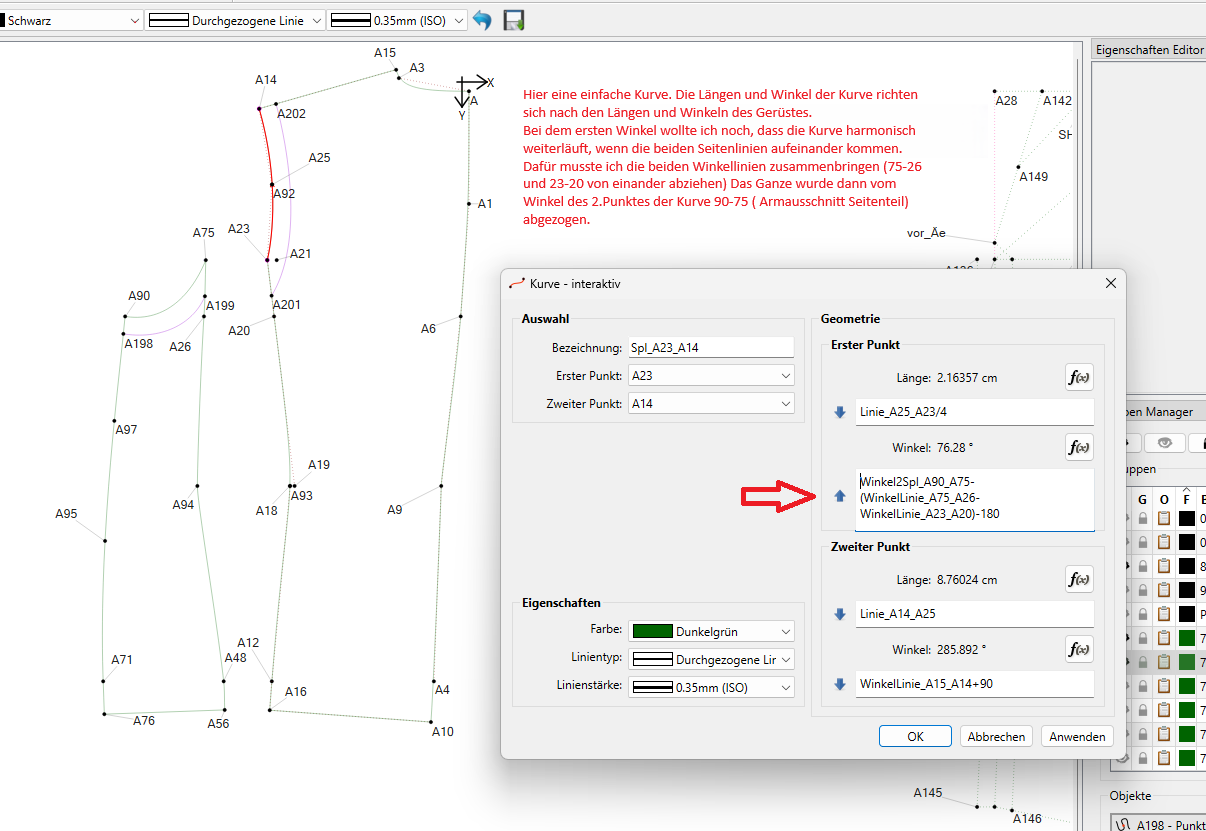
Ist das richtig, dass du versuchst auf einer Zeichnung deinen Schnitt aufbauen möchtest?

Mein erster Schritt ist der immer ein Gerüst mit Linien aufzubauen. Darauf zu achten ist, dass die Linienlängen an den Stellen die später beim Nähen aufeinandertreffen auch immer die gleichen Längen haben sollten. Die Kurven zeichnen ich dann im letzten Schritt. Dafür nehme ich dann die Winkel und Längen des Gerüstes.

Sollten eine Kurve an einer anderen anfangen, nehme ich den Kurvenwinkel der Ausgangskurve, damit immer ein rechter Winkel gegeben ist. Das passiert wenn ich eine Seitennaht am Armloch zeichnen möchte.

Ändere ich dann etwas an meinem Gerüst ( Hüftweite; Seitennaht ausstelle) weiß ich, dass die Kurve sich auch mit verändern.

Ich würde bei einer mir vorliegenden Zeichnung immer erst meine Zeichnung mit einem Gerüst überziehen wo maßgeblich die Stellen entscheidend sind wo sich Richtungen ändern. Besser ist es mit einem Buch arbeiten, indem beschrieben wist wie ein Grundgerüst aufgebaut wird und dann versuchen die Maße die auf der Zeichnung angegeben oder die du vielleicht an einem Model gemessen hast auf dieses Gerüst zu übertragen.

2 Likes

Hello

I’m having a bit of a hard time translating your comments (my German is a bit rusty).

I am not drafting based on the drawing, I have drafting instructions with me as well. However, the instructions don’t specifically tell me how to draft all the lines, it simply says “draw rest of the lines according to the sample drawing”. The sample drawing matches to the given measurements and proportions in the instructions, so it’s merely as a visual reference guide for me currently. IT essentially tells me if I am going totally out of bounds with my lines.

The base framework is there. the lengths don’t exactly match, as the draft has seam allowance included in places like side seam, armhole and shoulder seam. So the draft itself takes into account the difference that the cutline to seamline has.

I have a book that “explains” this framework used here, but it’s very barebones. In fact, it really has less information than the instructions I currently use. I have about 40 different drafting instructions for different jackets etc. based on this framework, but they all have some oddities that are not explained anywhere (for example, the dashed line in the armpit).

I have more experience with the Müller & Sohn system, which usually provides a lot more accurate information on how to draft the jacket and the details. This one has very few. Most common phrasing is either “draw lines as in the sample image” or “draw in the usual manner”. However, the usual manner is not explained anywhere… :slight_smile:

2 Likes

For example, here’s the side seam and hem as they result from my current efforts.

I suspect that the side seam curvature is partially result of the intakes and the dart, but I don’t really know and I don’t know how to take that into account, so I’ve just winged it.

The side seam length at the bottom is currently just based on a straight angle between the centerback and back hem - in the sample drawing it seems to curve, but this could just be a drawing error, printing error or misalignment in the scan etc. etc.

Also, the front side seam is made 1,5 cm longer than the back side seam purely based on measuring original jackets I have taken apart, but the sample drawing would suggest about 2 cm difference. I have no idea if the side seam length is correct, I suppose I will have to see how the toile works once I get that far.

If it doesn’t work, it’s back to the drawing board….

2 Likes

I just cut & paste into Google translate. :slightly_smiling_face:

3 Likes

Ein Schnitt wird immer ohne Nahtzugabe aufgestellt, gerade weil es wichtig ist dass Länge miteinander verglichen werden können.

Ich arbeite seid 40 Jahren mit BĂĽchern von MĂĽller und Sohn und seid ein paar Jahren mit BĂĽchern von Hofenbitzer. Dieses Buch kann ich sehr fĂĽr Sakkos empfehlen.

In der Regel müssen Nähte die zusammengehören die gleiche Länge haben, andernfalls müssen sie angeglichen werden. Ausnahmen sind die innere Beinnaht bei Hosen und die Seitennaht bei einem Kleiderärmel

2 Likes

I think the issue @Lieckio is having is that the jacket here is a period military frock not a modern mens jacket to be found in current modern books. Any of the old pattern books will often locate the critical measurement points of the basic block… and then in vague terms or with a simple diagram explain how to create the style lines.

There’s a lot more exceptions than that. Some other examples…the inner seam of a mens jacket 2 part sleeve are not the same… the inner seam of front sleeve should be a tad shorter. There are areas of the lining that have added ease or even pleats. The lapel / facing is always slightly larger so that the seam rolls to the underside and the lapel can roll. The underside of the collar is slightly smaller. The sleeve cap is always larger than the armhole. The back shoulder seam is usually 1/4" to 3/8" longer to account for the shoulder blade. I could go on, but the point is if every seam in a mens jacket is the same length.. it’s probably not going to hang or fit well.

3 Likes

Ja, das stimmt. ich wollte nur nicht alles aufzählen. Man muss die Längenunterschiede und Rollweiten jedoch auch immer vom Stoff abhängig machen.

Auch wenn es eine historische Jacke ist, kann ich meinen Grundaufbau nach aktuellen Grundschnitten aufbauen, muss dann aber alte Jacken oder Bilder als Vorlage benutzen um dem Schnitt den letzten Schliff zugeben. Ich weiĂź, dass es auch von MĂĽller und Sohn BĂĽcher ĂĽber KostĂĽme und historische Schnitte gibt.

Im Grunde ist es der gleiche Aufbau, wenn ich ein KleidungsstĂĽck als Vorlage habe um einen Schnitt daraus zu erarbeiten. Ein GerĂĽst hilft mir dabei das Model zu gestalten.

2 Likes

An easy way to translate text is to Right-click on the text that needs translating, to bring up the alternative menu and go down to the Translate and click on it. This is the alternative menu in Google Chrome:

Most browsers now have this option.

Ein Schnitt wird immer ohne Nahtzugabe aufgestellt, gerade weil es wichtig ist dass Länge miteinander verglichen werden können.

Except these pattern instructions do include the seam allowance - it’s also clearly evident in the armhole as well, where you can see the drawn corners of the seam allowance. If I measure roughly 0,7mm in from the drafted seams, I get a sewing line that is roughly even, though the side seam still has some ease built into it.

I’ve been working with books by Müller & Sohn for 40 years, and for the past few years also with books by Hofenbitzer. I can highly recommend this book for jackets.

I have this book, as well as many other Müller & Sohn books. However, this drafting method doesn’t slot directly into the same system, so often the ideas I get from using M&S system don’t help :zany_face:

I think the issue @Lieckio is having is that the jacket here is a period military frock not a modern mens jacket to be found in current modern books. Any of the old pattern books will often locate the critical measurement points of the basic block… and then in vague terms or with a simple diagram explain how to create the style lines.

Exactly this! I wish I had some formal training, so I could at least fall to some good practices or learned methods, instead of trying to invent so many things myself.

Auch wenn es eine historische Jacke ist, kann ich meinen Grundaufbau nach aktuellen Grundschnitten aufbauen, muss dann aber alte Jacken oder Bilder als Vorlage benutzen um dem Schnitt den letzten Schliff zugeben. Ich weiĂź, dass es auch von MĂĽller und Sohn BĂĽcher ĂĽber KostĂĽme und historische Schnitte gibt.

I also have this book, and it was essential for drafting sleeves on another period jacket.

Rather than try and fit this in the M&S system, I’d like to keep using these period instructions and understand the logic in them as I have about 40 different of these that I will eventually have to draft patterns for anyways :slight_smile:

4 Likes

Having spent 40+ years at my costume shop… more if you include my time spent at the University**… a lot of my experience has simply come from deconstructing period wear, making patterns, lots of sewing, adjustments to the patterns, more sewing… to the point where I can read the instructions in say The Blue Book by Croonborg or Designing Sack Coats, Dress Coats & Vests by Harry Simons and fill in the blanks when it will say something like “Shape from V down as shown by dotted lines”. Where translating that to Seamly it sometimes takes some ingenuity as there is no tool for “Shape from V down.” :slight_smile:

** My first real costume I constructed when at the University was a bustle dress for a production of La Ronde where I had to take the pattern off a real period dress my prof borrowed from the Costume Collection in NYC. I could not take the dress apart or damage it in any way. The theatre costume shop had these great work tables with this faux cork surface you could pin into… so the process I used was to lay down the pattern paper on the table, place the part of the dress I wanted to copy on the paper, and then pin through all the seams and corners. It was then just a case of connecting the pin holes and adding seam allowance. The tricky part is always dealing with any darts as you can’t take a dart apart. This was a technique I would use a lot over the years, and if I knew the size, it was always easy to grade to other sizes.

4 Likes

So I’ve got about 30 years still ahead of me of banging my head against the wall… :sweat_smile:

The sad thing is that local tailors were such a small group back in the day that they all learned the trade from their old masters and none of these techniques, details and “correct methods” were ever written down. By the 60’s the new, more formalized systems from abroad had taken hold and you could learn drafting in schools using those systems. And all the old knowledge was lost.

I have a tailor friend who is specialized in these old patterns and drafting methods as well, but even he mostly just tells me to wing it and “just make it look good”. Which is fairly easy to do on a single, hand drafted custom pattern. I can always fiddle things around a bit when cutting and sewing and adjusting after 1-2 toiles. But having to make a parametric one for a group of sizes does get more complicated.

I’ve actually first learned drafting for hats from an old hatmaker (15 years ago), who sadly has passed away. He had been the main drafter for a local hatmaking company, that has been making pretty much all the official hats for government, military etc. from 1870’s until 1990’s.

The method he taught me was a Russian (?) system, very similar the sheetmetal flat drafting methods I learnt in school. Here’s a great link to an English blog that showcases this method: Fashion-Incubator.com: Pattern Puzzle: mystery draft pt.2

As it is very technical and mathematical, I like to use it to draft hats - all I need is 3 views of the hat drafted in CAD and I can essentially kick out any hat I can imagine. This method is also a reason - I guess - why I always keep thinking that there must be some mathematical function or reason for drafting lines a certain way.

And that might be my downfall… reading older 19th century drafting books makes me assume there is some deeper mathematical idea behind all the lines, points, curves and arcs. But I’m starting to think that most of these may just be results of practice, experience and intuition. They probably could have defined everything with mathematical formulas as well, but there was no need.

After all, even a french curve follows a mathematical formula. It just doesn’t have to be a particular one to get shapes working the way you want in tailoring.

Well, that turned out to be a bit of a rant and a story :zany_face: but this is what happens when I sit in the office all day alone every week thinking about mathematics, curves and shapes. And trying to understand a 1930’s mystery mindset. Alas, progress is happening and everyday I learn something new!

4 Likes

This is turning into a bit of a blog, but I kept thinking about this pattern all night. And since now it’s time to break for a lunch break, I thought I’d share what I’ve got so far.

I’ve redrafted the intakes and the dart based on proportions of the waist. I noticed I had left an error in the draft earlier when testing stuff - the instructions say that L - W distance is waist divided by two. However, I had been testing proportions earlier to see what would align with the sample drawing. And I had added 0,5 cm to the L - W distance to get it to match with the sample drawing. I now removed it and it turns out that the centerpoints of the intake and the dart are 1/3 between the points 6 and W. I don’t know if this is correct, and if I make my jacket LONGER, the intake on the chest seems to become too short. Maybe it’s length should be proportional to the chest line, rather than the waist line?

Do ignore the pockets, they are just an early test I’ve left there as I was testing how the draft blocks work. They’ll be redone based on the measurements from the original pockets I have.

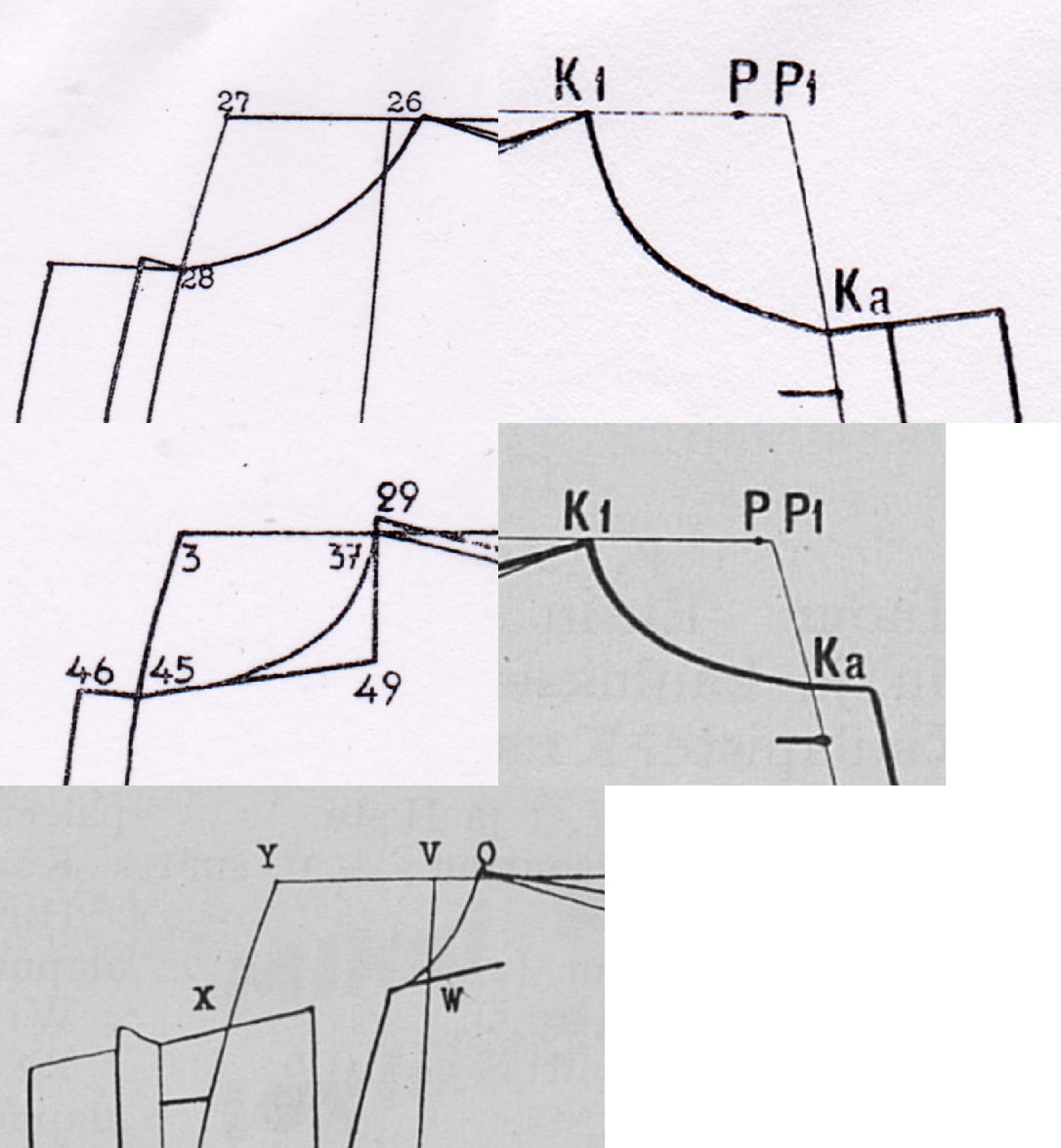
Once I’ll get a satisfying and working results with the intake and the darts, I can start tackling the collar… which is another mystery. I have 5 different versions of this particular jacket drafting pattern from different dates… none of them explain how the collar is supposed to be drafted and they are all different to each other, using different systems. Unfortunately, the three others (that don’t use K1, Ka, P and P1) are different shape to the real jacket. I suspect those instructions were made for officers jackets, rather than the basic one I am trying to make (they have a lot more shape to them).

Anyways, it’s not time for collars quite yet. Back to the drawing board after the lunch break.

2 Likes